A Quote from Andrea Branzi

by guy keulemans on March 27, 2012

Today, in order to create a new architecture and new urban spaces, it is necessary to to begin further upstream: one has to plunge one’s hands into that vast planktonic soup of products, technologies, pictures, signs and data which make up the artificial universe in which man is completely immersed.  It is an invasive and compromised artificial environment, but none the less it does constitue the only real urban space. Design, bravely operating within the world of production and consumption, has gained its new found supremacy through being the only planning entity able to transform reality.

Andrea Branzi, 1993.

{ Comments on this entry are closed }

Above photos by Dean McCartney.

Photo below by the designer.

{ Comments on this entry are closed }

Archaeologic, Sydney Design Week images

by guy keulemans on October 28, 2011

This stage of the Archaeologic project was exhibited during Sydney Design Week 2011 in collaboration with Henry Wilson.

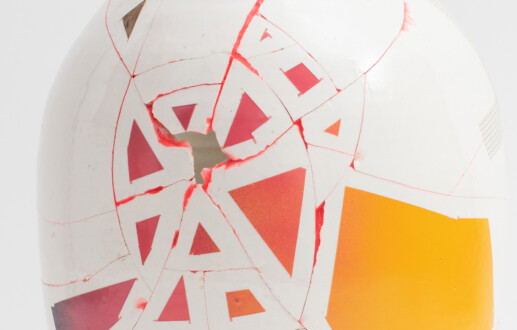
For other stages of this project I am using an approach adapted from kintsugi, the Japanese art of ceramic repair, embedding the photoluminescent pigment into deep glue seams running right through the bowls. For this project, Henry and I decided to focus on the common problem of chipped crockery – the kind of damage you see in crockery sold at second hand shops, which is where we obtained these samples. The pigment is applied as filler within the chips and sanded back to restore the unbroken shape, but with a nice surprise when you open your cupboards at night.

The exhibition case was built with a timed light switch similar to the ones they used to use in museum displays (at least the ones I remember from my childhood), except that the switch is reversed; pressing the button turns the light off for 30 seconds, instead of on.

In situ on Elizabeth Lane during Sydney Design Week:

{ Comments on this entry are closed }

Archaeologic: first image

by guy keulemans on September 30, 2011

Broken white stoneware repaired with photoluminescent pigment.

{ Comments on this entry are closed }

Archaeologic at Sydney Design Week

by guy keulemans on July 31, 2011

My new project with Henry Wilson is now on show during Sydney Design Week 2011. Details below.

Archaeologic

Seeing potential in the look and feel of broken things, Guy Keulemans and Henry Wilson present an act of protest against the new. The transformative power of repair is harnessed in a collection of objects which celebrate a synthesis of Japanese kintsugi, archaeology, and light.

The street exhibition is on view in the laneway behind 617 Elizabeth Street Refern during Sydney Design Week between 11am and 5pm daily.

Studio 1, 617 Elizabeth Lane (behind 617 Elizabeth Street)

Facebook event page.

{ Comments on this entry are closed }

NNancy at PYD

by guy keulemans on April 7, 2011

From March 18 to April 19th my installation NNancy is on show at the PYD Building in Sydney. A spatial intervention built from a simple fixed modular component, the structure generatively becomes complex as it caterpillers its way up the central staircase. I, with a rotating group of assistants, are building the structure live on Tuesdays the 29th March, 5th of April, and 12th of April, with a pulldown on the 28th April. The pulldown is, in a way, as interesting to me as the build up because I film the process and use it to make animations, like the one below, but in real rather than virtual space.

The work is a sequel to my recent exhibition in Poland, WWilma, a similar structure, but whose form was built by visitors and controlled by demographic factors. It grew to massive proportions in the cultural centre which housed it, akin to an out of control architectural growth, temporarily, but drastically changing the interior space. NNancy, built for the first time in the PYD building, is smaller and less monstrous, but possesses more defined geometric parameters; an invitation to thoughts about the relationships between art and nature, control and chaos.

NNancy from yugyug on Vimeo.

NNancy: a spatial intervention by Guy Keulemans
The PYD Building
197 Young Street, Waterloo, NSW 2017, Australia
18th March to 28th April
Hours: Monday to Friday – 9am to 5:30pm
Saturday – 9am to 5pm
Sunday – 9am to 4pm

Information at the PYD website:
http://www.pyd.com.au/exhibitions-4785/generative-installation-nnancy-pyd-during-april.aspx

{ 0 comments }

Kids Energy House at Archizoom.pl

by guy keulemans on January 4, 2011

Pawel Kraus from Poland’s Archizoom has written about my project Kids Energy House, here.

{ Comments on this entry are closed }

WWILMA at the Centre of Contemporary Art in Torun

by guy keulemans on December 16, 2010

The exhibition Tag! Base! Hide and Seek! has opened successfully at the Centre of Contemporary Art in Torun, and  WWILMA has begun. This was project was difficult for me because I was unable to travel to Torun and set it up myself, but instead sent an instruction manual to the curators. That makes a fair amount of sense, considering its built by the art centre visitors, and, as the video stream shows, they did an excellent job and its running like a dream. Already it is quite large, with a large chaotic arrangement in the foreground and some nice smaller, disconnected satellite arrangements in the background. As the structure expands, will these join up and intensify?

Click the link below for the live video stream. Works in most browsers, Chrome and Safari certainly, it will also open in VLC. Keep in mind the time difference – at night the centre closes and turns off the lights, and all you see is black :/

WWILMA at COCA, live video stream

{ Comments on this entry are closed }

WWILMA will begin growing soon in Torun, Poland

by guy keulemans on October 29, 2010

Earlier this year I was asked to contribute to the soon to be released Platform 21 book. My contribution was a series of sketches proposing an structure built by the visitors of an exhibition which represents their demographic qualities by translation into physical structure. Its both interactive and generative, and somewhat like an infographic or diagram, but three dimensional, large and architectural. It divides space in a very physical way. Curator Joanna van der Zaanden liked the idea and is taking it to Poland where it will grow for the first time under proper conditions at the Centre for Contemporary Art in Torun, Poland. I have an instruction manual and a few details to work out before its opens on the third of December, but I’ve already built a smaller scale prototype with artificial demographic data, so it at least has been tested structurally.

Above, the prototype in Berlin. It represents 50 exhibition visitors and fills up a room of about 22 square metres. In fact it escaped out the door and ended up on the street. With visitors in Torun estimated at more than 1000, the structure there will be perhaps 20 times larger.

Thanks to Mirak Jamal and Marwin Bald for the use of their cellar studio and  gallery in Berlin.

{ 0 comments }

Artichoke and Belle articles

by guy keulemans on October 29, 2010

I was recently featured in the July-August issue of Artichoke, Australia’s design and architecture magazine. It was a very nice profile written by Dutch design journalist Ingeborg van Lieshout, who also writes for a number of important Dutch entities like Bright, Frame and Mediamatic, as well as for her own site The Green Light District.

And soon after in September I was in Belle, the lifestyle and interior magazine, alongside Kyoko Hashimoto. We were instead asked to recommend things to do in Berlin for a travel feature, so we recommended some of the kookier bars, places to stay, and eat (especially Claudia and Nico’s amazing ad-hoc Sunday restaurant at Sowieso) and discussed the influence of the city on our work.

{ 0 comments }

Superunfoldedbox write up in Art Forum

by guy keulemans on July 22, 2010

The May 2010 issue of Art Forum has a review of the Marres Centre’s We Were Exuberant and Still Had Hope. Ettore Sottsass: works from Stockholm, 1969 exhibition. The author Saskia van der Kroef writes:

….designer Guy Keulemans provided “notes” to Sottsass’s Superbox. Keuleman’s Objects for Atheists, Superunfoldedbox, 2009, comprising different kinds of cardboard posters that function as a DIY kit, turned the institution’s second floor into a playful cityscape of ill-shaped miniature Superboxes. Mass-produced, touchable, light and disposable, they were in complete contrast with the originals downstairs. The young designer clearly broke with the Superbox’s sacral staging, directly invoking the conditions of consumption. At the same time, the work illustrated the promise of an entirely designable society, with the participation of the viewer – but not without an exuberance of its own.

{ 0 comments }

The Identity & Para Identity of Tobi Wong

by guy keulemans on June 26, 2010

The celebrated young designer Tobias Wong died recently at the age of 35, officially by suicide. However, it appears he may have killed himself accidentally while sleep walking, a condition with which he had long been afflicted. In this post I speculate on how and why his ultimately tragic condition may have also contributed to the startling originality of his work.

I was surprised and shocked last month to hear of the death of the  Tobi Wong. Its true that talented people die all the time, but the news came quickly that it was suicide, and this is unusual for designers. They don’t tend to have the angst or terrible passions that strike misery into the hearts of the famous musicians and artists who kill themselves.

Of course, Tobi Wong was an artist; his work provocatively poked fun at the establishment and critiqued the trappings of consumer society, fertile area for many contemporary artists. Considering this, was he an Ian Curtis or Vincent Van Gogh, troubled by depression and tortured by the imperfections of his own art? It doesn’t seem likely, because his work and personality was light hearted and, in general, ironically sweet and aesthetically pleasing. Although he played with the paradox of producing things that criticised material production (for example the Wrong Store, which never opened, or his collaboration with Paper magazine) actually his work sold well, and is found in many shops both physical and online. In one interview he relished the opportunity to have been published in Teen Vogue, a magazine with a circulation well beyond the specialty magazines of his own profession. In many regards, he was an artistically and commercially successful designer at the peak of his career.


Yesterday, a fascinating article in the New York Times written by Alex Williams, proposed that he didn’t intend to kill himself at all. Williams discovered that Wong was afflicted by sleeping disorders, and Wong’s boyfriend Tim Dubitsky is convinced he hung himself while sleep walking. Bizarre as this sounds, the anecdotal evidence is strong; his friends and family tell stories of Tobi getting up in the middle of the night and exhibiting strange sleep walking behaviour – cooking 3 course dinners, randomly billing clients and writing nonsensical emails. On one occasion he made costumes for his cats. When Tobi visited his mother in her high rise apartment, she would stack chairs by the doors to prevent him from accessing the balcony ledge. On another occasion, he was said to have removed a treasured painting from the wall and violently thrown it across the room.

I can believe it. I have a history of sleep walking too. Sometimes I wake up and act out conversations with strangers, or speak gibberish to friends. More than once I have left my room and woken up in strange beds, or found myself naked inside elevators, locked out of my apartment. Awkward situations. Parasommnias, sleep disorders and sleep walking tend to affect families, and my brother too once sleep walked while at college, falling down some steps and badly cutting his head open. Once, while camping in Croatia, my girlfriend tied her hand to mine with string, to prevent me from getting up in the night and falling off the nearby cliffs.  Never, ever, however, could I imagine a tragedy on the scale of what happened to Tobias Wong. And yet, it is not unknown; both the popular media and medical literature are rife with stories of misadventure, death and even manslaughter being commited by those technically asleep. In these conditions the pre-frontal cortex of the brain is disconnected, and the afflicted may have no more control over their actions than they would over a simple dream.

I think its interesting to consider that this condition of Wong’s may have been intricately linked to his style and approach to art, but I preface these ideas by saying its entirely supposition.


It appears he had a dual life; a waking life, and a dream life that was acted out, but vaguely remembered or known only through the recollections of family and friends. Did he feel like he had a dual identity? A somnolent doppelganger? Much of Wong’s work deals with appropriation of the work of others; my favourite is his Savoy doorstop. Its  a wry take on Alvar Alto’s famous vase, which was filled with concrete to make the doorstop. And each doorstop requires another Alto vase to be broken;  a bold move by a young designer to place his own work at a higher premium than that of the Finnish master. Of course, the other well known examples are the Starck chair he fitted with a light and the cut up Issey Miyake skirt.


Did he feel that these appropriations were possible, or more conceivable, because of his own fractured sense of identity?  Did he conceive that he was acting out the dream lives of those he appropriates by proxy? In a parallel universe does Starck dream of putting a light in his own chair? Did Issey Miyake have a nightmare of seeing his skirts turned into monitor covers? In our universe, Tobias Wong made these imaginery events delightfully real and amusingly tangible.


At the Core 77 Design, Wit, and the Creative Act conference in 2007, Wong staged an interesting fraud by substituting his friend, academic Rama Chorpash, in his place as speaker and panel member. This is by no means original to Wong – its a core aspect of Dutch artist Barbara Visser’s oeuvre and more recently the avant garde International Necronautical Society pulled the same stunt at the Tate. However, one can speculate that Wong was not just playing with authenticity or circumnavigating his own fear of public speaking, but also performing a voyeuristic fantasy; an act of observing his identity externally. One can imagine that having his sleep walking activities related to him third hand, by friends and families, “the morning after”, may have cultivated an intense desire to observe himself in the way they did. Something he could not do while sleepwalking, could be done by proxy. Wong attended the event semi-anonymously and is described sitting with the audience, grinning with glee at his own prank.

Other examples of his work show an intent to observe himself externally. I had previously thought his 1997 self portrait The Stolen Shot, in which he photo bombed a picture at the beach by popping his head into the frame of a couples own photograph, was a early expression of his interest in appropriation and inserting his personality into the work of others. Yet, an alternate explanation is that he was struggling to see himself as his sleepwalking phantom, a ghostly and distant entity. Perhaps, a way to see himself in the same way his close friends and family had seen him. Was his later work, Sleeping at Agnes, in which he slept at night in the window of a boutique, visible from the street, an attempt expose his condition to the public? An attempt to share his families’ experiences with a wider audience? 


Some aspects of Wong’s life and work take on dark new meanings in light of his sleeping disorder. His well known tattoo, “Protect me from what I want” scribbled in pen by the artist Jenny Holzer on his arm and later tattooed permanently, now seems presciently sinister. Wong described his own work with the name paraconceptual. The prefix para, when used as from its Greek origin, means beside, adjacent, and resembling, but also abnormal. The term describes Wong’s work well, working alongside the mainstream and resembling it, but also subverting the mainstream with beautiful abnormality. I can’t think of a better example than his diamond ring, the diamond flipped around to act as a weapon, or tool for destruction.
However, the prefix para also has a Latin origin, from parare meaning “to shield” and its from this origin we have words such as parasol and parachute, objects which protect us. Some of his work expresses this concept directly, notably his kevlar rose brooch and duvet, but I think his work is also protective in a more abstract and significant way. Tobi Wong was familiar with the experience of somnolence, the feeling of automatic and aimless nocturnal wandering, the moving and performing of actions without awareness. Maybe he saw all of us as sleep walkers; wandering through life buying, producing and consuming automatically. Perhaps he recognised this somnolent-like, but daily behaviour as dangerous? If so, what Tobi Wong really did with his life and work was to give us is a collection of ideas and objects – things to protect and guard us from the problems of production and our own blind, happy consumerism.

NOTE: The majority of the images I use in this post were sourced from Tobi Wong’s own site www.brokenoff.com which is currently offline. But I hope www.brokenoff.com can be restored because it gives a good sequential overview of his work, including lesser known work from early in his career.  Update: looks like there is a mirror at brokenoff.net

{ 0 comments }

The Grey Zone

by guy keulemans on June 17, 2010

This saturday opens Die Grauzone, an exhibition at Kaleidoskop in Neukolln, Berlin. My project Greygoo is designed specially for this exhibition. The exhibition is part of the larger art festival 48-Stunden-Neukölln.

{ 0 comments }

Fashion Clash 2010 Magazine…

by guy keulemans on June 17, 2010

I recently contributed to the magazine associated with Fashion Clash 2010 in Maastricht (June 4th to 6th), an event curated on the idea of fashion being produced by designers from fields other than fashion. Based on the photos posted online at Design.nl, and the ones posted by curator Matylda Krzykowski, the event was a mega-success.

My article in the magazine discusses the dressed-down minimalist aesthetic you see on the streets here in Berlin, and some of the eclectic shops that cater to it (specifically Nr4 and the Line Gallery) plus my own shop We Are All Made of Stuff. I’m eagerly awaiting my own copy to be sent to me by Matylda soon, but for everybody else its available from all Selexy bookstores, as well as the Bonnefanten Musuem in Maastricht and the Van Abbe Museum in Eindhoven.

The following images are by Peter Stigter. For more great images check out the Fashion Clash 2010 blog or Facebook page.

\

{ 0 comments }

This evening in Breda, the Netherlands, Jose Subero, a classmate of mine from the Design Academy Eindhoven, is presenting a lecture on his innovative proposal to transform the city of Sao Paolo, by making use of its empty billboards, free from public advertising since 2007. In this article I introduce his project and discuss the different qualities art, sculpture and technology can posses when situated in public space.

The technical development and deployment of large scale video screens – I am conflicted about using the new industry term ‘urban screens’ – has increased dramatically in the last decade. Mega cities like Tokyo and New York have lead the way, but smaller, and more conservative, cities are attempting to catch up. Organisations exist to promote their deployment and the generation of content for them. Supposedly not always advertising…
I am not a fan. Its not that I don’t enjoy watching these large screens sometimes. When I was very young, I stood in awe outside a drive-in movie screen in Melbourne, perhaps the last of its kind in that city, while they screened First Blood, the first Rambo movie. The screen was so large it was easily visible from outside the fence. I was astounded. Likewise, the enormous advertising screens you see in Shibuya are superficially amazing. Once, when I was living in Tokyo, I saw the same walking Brachiosaurus that amazed Scarlett Johansson’s character in Lost in Translation. Yet, I don’t have to live or work in Shibuya with any frequency, which I believe makes a difference to the impact of these advertising screens.
There are alternatives however; technological developments in projection have recently enabled large scale projections onto buildings and other urban structures:

In this last example, the projector is hidden and the spectacle temporary. Afterwards there is nothing left, but empty space and whatever the architect or city planner intended. The problem with large screens is that they need physical and vertical space, a permanent billboard, on which to work. These either block sunlight or vista, if free standing, or architectural facades if adhered to the sides of buildings. Not so enjoyable for the windowless tenants inside. Think of them like a price tag on an artwork…. (This is just rhetorical – unfortunately I can’t actually imagine all architecture has the same status as art.)
In the digital age a video screen is a blank canvas capable of displaying anything, including public and interactive art. New technologies even permit semi-transparent screens. Should this mean a tolerance for such structures? Or the kind of sanctity reserved for public artwork such as statues or sculpture?
Their are certain differences that structures like statues and public skulpture have compared to technological objects like animated projections or screens with moving images. One is that they are static, they don’t change over time and so vanish from our perception when we do not have the time or inclination to perceive them. Consider this optical illusion as an analogy.
The human mind seems biologically wired to ignore static visual information, and perhaps this is essential in the urban environment. Personally, I have a wandering mind and have a hard enough time paying attention to life threatening traffic when walking around the city. It won’t get better for me; this article gives an indication how, at the current rate of deployment,  urban video screens will dominate our lives within the next few years. I suppose as human animals we have a remarkable ability to adjust to environmental changes, but…..
Another difference is the temporal quality of the structure. Statues and sculpture tend to last for a long time, so permanence and timelessness, is part of the feeling they provoke, which I think in the case of public art is a good thing. TV screens and other technology devices with a visible and physical body don’t have this timeless quality, because the rapid changes in their internal technology produce aesthetic changes in their form. They are perceived as period objects. Even my use of the phrase TV screen feels outdated. What modifier should be placed in front of ’screen’ to make us understand what it actually is? Video-screen-, movie-screen , digital-screen,…  these phrases have or will become outdated, just as the forms they make us think about are outdated. This is a fundamental problem with technology.
My grandfather, the architect Nevile Gruzman, commented on this problem to me once, when discussing a car sales room he had designed in the 1950’s. It was photographed by Max Dupain in 19955, and decades later my grandfather reflected that while the building in the photographs still looked reasonably contemporary, the cars, as technological objects, had dated far more. The chaining of an object to the period in which it was created is directly related to the amount of technoogy it contains. In fact it is the cause, along with fashion trends and the desire for change in general, of the period style itself. So of course its pronounced with product design; just look at any old home electronic device and you can pick the decade in which it was produced with ease. The very best industrial designers, Dieter Rams, Bang &Olufsen, even Ettore Sottsass, worked to resolve this problem, but their work is still dependant on the underlying material, technology, which, over time, is a slippery and polymorphous sculptural material. Marble it is not.
Large outdoor video screens can be compared to the traditional family television (before we all had our personal devices in our rooms and pockets) in that they can bring people together for a time based event. You see this with drive-ins and at big rock concerts. This is an attraction to urban designers and advertisers, because they imagine a public crowd slack jawed en masse in amazement. But the analogy is false because it only works for temporary spectacles. When a permanently installed video screen is run continually, and they always are because to turn them off makes no aesthetic or economic sense, they soon become banal. In Shibuya and Times Square the locals ignore them and really its only the technologically star struck tourists that stand around slack jawed. Ubiquity begets banality.
A more exciting 21st century concept is to get rid of them all together, billboards and advertising signage included. This is exactly what the Brazilian city of Sao Paolo has done.  In 2006 they passed a law requiring all advertising to be removed from the city’s billboards. They are left vacant and empty, but also transparent; structures through which light can penetrate. I have heard stories about residents in the densely packed city awaking to find fantastic views from their apartment, right to the horizon, through billboards previously covered with cigarette advertisements.
Something still needs to be done with these industrial skeletons. One proposal is from a former classmate of mine from the Design Academy Eindhoven’s Humanitarian Design program. José Subero has proposed an exciting concept to use them as ‘greenboards’; places to grow plants and vegetation. Their location inside the city makes them perfect for food gardens, or even threatened species that require tending and care. The concept images and video illustrate the transformation this proposal could have on the city. A partial proof of concept has already been made in collaboration with Sao Paolo architects Bijari on a small vacated billboard opposite the Fundação cultural de Curitiba, though as Subero notes in his blog Naturezas Urbana, this deployment is different to what he proposes for the large industrial steel structure which he imagines would have have the most impact. The benefits of this idea when applied on a large scale are, I hope, obvious, but Subero iterates some of them: improved oxygen emissions (in a smog filled city), improved bio-diversity of plants but also animal bio-diversity, tourism and socio-cultural benefits plus potentially carbon credits.

My position is that in a world with larger and larger cities and less access to farms and forests, we should be integrating nature into the urban environment as much as possible. More parks, city farms, (public and private), rooftop gardens and something growing everywhere. Trust me, I’m not a hippie or a luddite; these changes will have aesthetic, social and economic benefits. Technological infiltration must be minimal, and technology itself practically invisible. This is happening slowly already thanks to miniaturisation. The development of intra-personal device technologies such as augmented reality will mean that the real world and virtual information can be meshed discretely and viewed privately or shared at the users will. For the creation of large scale shared spectacles there is projection on the sides of buildings and urban structures. I sometimes think that people, especially designers, love video screens so much because they saw them in sci-fi movies like Blade Runner when they were children. As visionary as science-fiction movies can be, do they serve as reliable guides for the non-fictional future?
Jose Subero speaks tonight the 20th May 2010 at the Graphic Design Festival Breda, in the Netherlands, details here.
UPDATE: The idea to do away with the content of billboards, but make new use of their structure, might be spreading. Recently I found out about this swingset concept from Mésarchitecture. Below that, is a new sculpture from Lead Pencil Studio on the border between the States and Canada, which proposes to advertise “nothing but clean air”. I think its an interesting sculpture, but find its use of the billboard negative space convoluted. Unlike Jose Subero’s and Mesarchitecture’s concepts, they are re-creating the silhouette of a form that purportedly want to remove? It seem’s counterintuitive. On the other hand, its aesthetic, mimicry of a self-assembling parasitic organism, suggests a post-apocalyptic interpretation; the sculpture has surrounded, enclosed and outlasted an old billboard used as scaffolding.


List of Images in order from the top down:

  • Naturezas Urbana (Jose Subero)
  • Urbanscreens.org
  • Flickr user: enuwy (Creative Commons Attribution-NonCommercial-NoDerivs 2.0 Generic)
  • A doctored image of Rambo on a drive-in screen
  • projection on Gorey Castle by Evan Grant / Seeper for the Branchage Festival 2009
  • Cloud Gate by Anish Kapoor
  • Two images of Purnel Motors, Sydney, designed by Neville Gruzman, photographed by Max Dupain in 1955
  • Gillete Supermax Pro 1300 uploaded by Flickr user: Faasdant.  Probably not designed by Dieter Rams, but by Morison S. Cousins, although Rams worked for Gillette’s parent company the influence is clear.
  • HiFi that is designed by Dieter Rams
  • urbanscreens.org
  • Naturezas Urbana (Jose Subero)
  • video from Naturezas Urbana (Jose Subero)
  • Mesarchitecture’s Double Happiness
  • Lead Pencil Studio, photo by Ian Gill

Note that some of these images kind of express the opposite of the point I am making. Makes it interesting that way.

{ 0 comments }

In 1864 Jules Verne wrote “Journey to the Centre of the Earth”. Informed by new discoveries about the geology and the age of the earth, the novel attempted to equate levels underneath the surface of the earth with a hierarchy of older and older geologic time. Which is why the protagonists encounter Neanderthal men, and prehistoric animals, ultimately dinosaurs, as they go deeper and deeper into the earth. We know now that this is complete shit and really the centre of the earth is a solid ball of iron the size of the moon – possibly a single giant crystal –  surrounded by a molten lake of liquid iron and nickel. Despite what we already know or can presume, scientists want to know more, and the latest idea is to start a nuclear fission reaction inside a big ball of radioactive cobalt; making it so hot it literally burns through the crust and starts to sink towards the centre of the earth.
Most of what we know already about the earths core is comprised of theoretical modelling and real observation of the environment around us, even extending into space. For example, scientists can estimate the the type and quantity of elements that make up the solar system by analysing lightwaves coming from the sun and reflecting off other planets. The know from this the expected ratio of elements that make up the earth, but the samples we can physically access, from the earth’s crust, are low in iron. So its predicted that the rest of the earth, specifically the earth’s core, contains a lot of iron.
The study of seismic waves from earthquakes gives us other information. When an earthquake occurs, waves travel all over the world, both around the crust, along the surface of the earth, and also directly through the earth, which can be recorded and analysed on the other side. A certain type of wave doesn’t make it through certain parts of earth’s interior though, and these are the type of waves which don’t travel though liquid. So we know that part of the earth, outer core is made of liquid. Molten iron.
If the outer core is molten iron, the inner core is actually frozen iron. Its not any cooler, but the increasing pressure of the earth raises the boiling point of iron, so that inner core is actually growing solid, collecting more and more iron from the liquid outer core, as the earth slowly ages.  Theoretically, there must be an exchange barrier between the inner and outer core comprised of trace elements with melting points different to that of iron. This should function like a super slippery lubricant, allowing the inner core to rotate independently of the liquid iron around it. So its expected that the earth’s core rotates slower or faster than the earth itself, but no one knows for sure.
Above all this seemingly unstable collection of iron and trace metals is the mantle. We know a bit about what the mantle is made from, because bits of it spew up out of volcanoes every now and again. Its where stuff like diamonds, bits of carbon crushed into incredibly tight molecular structures, are made over the course of billions of years. The mantle is where the big shifts in temperature and pressure occur, the closer materials get to the core, and subsequently the mantle has lots of different layers with different compositions of various elements. The mantle is really the source of all the stuff that comprises the crust of the earth and, using techniques I don’t attempt to understand, geologists can tell from which part of the mantle the rocks we find on the surface of earth come from. They can even tell from which level of the mantle specific diamonds come from, based on the study of impurities they contain.
A full understanding of how the mantle is constructed, however, will require physical access. The deepest hole in the world, the 12 kilometre deep Kola Superdeep Borehole, dug by some Russian scientists,  reaches no where near the mantle, but did go deep enough to prevent further drilling from the excessive heat of 180°C, and deep enough to inspire the hoax that they had drilled into the mythological Christian “Hell”. This was first reported  by an evangelical news station in the United States in 1989, presented with a sound recording of the screams of the dammed, recorded with a “special heat-proof microphone” that was lowered into the hole. It has made its way around the internet for years since then.
Some Japanese scientists have been digging into the much thinner crust at the bottom of the ocean. They haven’t reached the mantle yet, but are choosing especially weak places to drill, where tectonic plates overlap, so as to study the occurrence of earthquakes. They even want to drill into the epicentre of the earthquake that caused the 2004 tsunami. This all sounds very counter intuitive to me, but if it leads to a better understanding of earthquakes and tsunami, and more scientifically accurate Godzilla movies, I guess its for the best.
All of the above is pretty small scale compared to what’s coming though. In 2003 planetologist David Stevenson, of the California Institute of Technology, proposed to crack open the crust of the earth with the use of nuclear weapons and pour a probe covered in molten iron into it. The power of the blast, several megatons, and the weight of the molten iron,  108 to 1010kg, would make the crack self-propogate right down to the core. The probe would descend down this deepening crack while sending back data to the surface. That the nuclear explosion would be in the megaton range makes me guess he was probably joking, but some Russian and British scientists have improved on the basic idea and seriously proposed a variation.
In a series of papers, 2005’s “Probing of the Interior Layers of the Earth with Self-Sinking Capsules”, published in the journal “Atomic Energy”, followed by 2008’s “Exploring the Earth’s Crust and Mantle Using Self-Descending, Radiation-Heated, Probes and Acoustic Emission Monitoring” published in the book “Nuclear Waste Research: Siting, Technology and Treatment” the scientists propose the design of probe built from radioactive cobalt surrounded by a tungsten wall. The intense heat from probe will cause it to literally melt into the earth, travelling slowly down through the crust and then mantle at the rate of about 20 kilometres per year. The cobalt will continue to generate radionuclides for several decades, allowing it to sink deeper and deeper. Although the probe is essentiall dumb, just a collection of nuclear fuel with no technological devices, the probe can be tracked by equipment listening to the changes in the earth it creates as it sinks; the melting rock and its re-crystalisation in the wake of the probe.
This concept has a historical precedent.  When Reactor no. 4 at Chernobyl had its catastrophic meltdown in 1986, there was a realistic concern that the exposed core would also literally melt in to the ground and start sinking down. Potentially this would made the disaster much worse, because there was an underground aquaduct below the reactor (used a s source of water coolant for the whole Chernobyl complex) and if the core came in contact with the water the resulting steam explosion would destroy the remaining three reactors above ground (which amazingly were still operating and continued to operate until the early 90’s.) Luckily this event was averted by having several helicopters fly over the reactor core and smother it in lead, clay, boron and canisters of liquid nitrogen. If the the threat of a steam explosion was not present, would the reactor have been left to to burn its way down to  the centre of the earth?
When I first told my girlfriend about this idea, she exclaimed “kowai!”, meaning scary, a word the Japanese reserve for phenomena like atom bombs, tsunami and Godzilla. She asked, “Aren’t they afraid they will set off a chain reaction and explode the earth?” I am not a scientist and could hardly guess, but I teased her with the information that the earths outer core also contains a fair amount of nuclear fuel, in the form of molten uranium, but that the scientists are willing to take the risk anyway.
More interesting to me, as a designer and not a scientist,  is the difference the form of such a probe takes, when compared to space faring probes like Voyager, Huygens and Mariner. Those latter probes travel thousands of kilometeres to other planets and their moons carrying sophisticated cameras, sensors and other scientific probes, and transmitting back amazing pictures and data of their journeys. The cost millions if not billions of dollars and require the co-operation of the worlds best scientists and governments. Yet, to send something a few dozen kilometres or so into the centre of the earth, our best solution is dumb probe;  a bundle of nuclear waste bunched together and set it on fire so we can watch it sink into the ground. By modern scientific standards, its like finding  a human corpse in the woods, poking it with a stick and calling that an autopsy.

journey

In 1864 Jules Verne wrote Journey to the Centre of the Earth. Informed by new discoveries about the geology and the age of the earth, the novel attempted to equate levels underneath the surface of the earth with a hierarchy of older and older geologic time. Which is why the protagonists encounter Neanderthal men, and prehistoric animals, ultimately dinosaurs, as they go deeper and deeper into the earth. We know now that this is complete shit and really the centre of the earth is a solid ball of iron the size of the moon – possibly a single giant crystal –  surrounded by a molten lake of liquid iron and nickel. Despite what we already know or can presume, scientists want to know more, and the latest idea is to start a nuclear fission reaction inside a big ball of radioactive cobalt, becoming so hot it literally burns through the crust and starts to sink towards the centre of the earth.

Most of what we know already about the earths core is comprised of theoretical modelling and real observation of the environment around us, even extending into space. For example, scientists can estimate the the type and quantity of elements that make up the solar system by analysing lightwaves coming from the sun and reflecting off other planets. The know from this the expected ratio of elements that make up the earth, but the samples we can physically access, from the earth’s crust, are low in iron. So its predicted that the rest of the earth, specifically the earth’s core, contains a lot of iron.

llnl_earth

The study of seismic waves from earthquakes gives us other information. When an earthquake occurs, waves travel all over the world, both around the crust, along the surface of the earth, and also directly through the earth, which can be recorded and analysed on the other side. A certain type of wave doesn’t make it through certain parts of earth’s interior though, and these are the type of waves which don’t travel though liquid. So we know that part of the earth, the outer core, is made of liquid. More specifically, molten iron.

If the outer core is molten iron, the inner core can be considered frozen iron. Its not any cooler, but the increasing pressure of the earth raises the boiling point of iron, so that inner core is actually growing solid, collecting more and more iron from the liquid outer core, as the earth slowly ages.  Theoretically, there must be an exchange barrier between the inner and outer core comprised of trace elements with melting points different to that of iron. This should function like a super slippery lubricant, allowing the inner core to rotate independently of the liquid iron around it. So its expected that the earth’s core rotates slower or faster than the earth itself, but no one knows for sure.

Earth-crust-cutaway-English-Large_label

Above all this seemingly unstable collection of iron and trace metals is the mantle. We know a bit about what the mantle is made from, because bits of it spew up out of volcanoes every now and again. Its where stuff like diamonds, bits of carbon crushed into incredibly tight molecular structures, are made over the course of billions of years. The mantle is where the big shifts in temperature and pressure occur, the closer materials get to the core, and subsequently the mantle has lots of different layers with different compositions of various elements. The mantle is really the source of all the stuff that comprises the crust of the earth and, using techniques I don’t attempt to understand, geologists can tell from which part of the mantle the rocks we find on the surface of earth come from. They can even tell from which level of the mantle specific diamonds come from, based on the study of impurities they contain.

tundra_sm

an illustration of Kola Superdeep Borehole by Egil Paulsen, looking across the Kola Peninsula

A full understanding of how the mantle is constructed, however, will require physical access. The deepest hole in the world, the 12 kilometre deep Kola Superdeep Borehole, dug by some Russian scientists,  reaches no where near the mantle, but did go deep enough to prevent further drilling from the excessive heat of 180 degrees Celsius, and deep enough to inspire the hoax that they had drilled into the mythological Christian Hell. This was first reported  by an evangelical news station in the United States in 1989, presented with a sound recording of the screams of the dammed, you can listen to it here, recorded with a “special heat-proof microphone” that was lowered into the hole.

Hell

hell1

Some Japanese scientists have been digging into the much thinner crust at the bottom of the ocean. They haven’t reached the mantle yet, but are choosing especially weak places to drill, where tectonic plates overlap, so as to study the occurrence of earthquakes. They even want to drill into the epicentre of the earthquake that caused the 2004 tsunami. This all sounds very counter intuitive to me, but if it leads to a better understanding of earthquakes and tsunami, or more Godzilla movies, I guess its for the best.

All of the above is pretty small scale compared to what’s coming though. In 2003 planetologist David Stevenson, of the California Institute of Technology, proposed to crack open the crust of the earth with the use of nuclear weapons and pour a probe covered in molten iron into it. The power of the blast, several megatons, and the weight of the molten iron required,  between 100 000 tonnes  and 10 000 000 tonnes, would make the crack self-propogate right down to the core. The probe would descend down this deepening crack while sending back data to the surface. That the nuclear explosion would be in the megaton range makes me guess he was probably joking, but some Russian and British scientists have improved on the basic idea and seriously proposed a variation.

In a series of papers, 2005’s Probing of the Interior Layers of the Earth with Self-Sinking Capsules, published in the journal Atomic Energy, followed by 2008’s Exploring the Earth’s Crust and Mantle Using Self-Descending, Radiation-Heated, Probes and Acoustic Emission Monitoring, published in the book Nuclear Waste Research: Siting, Technology and Treatment, the scientists propose the design of a probe built from radioactive cobalt surrounded by a tungsten wall. The intense heat from probe will cause it to literally melt into the earth, travelling slowly down through the crust and then mantle at the rate of about 20 kilometres per year. The cobalt will continue to generate radionuclides for several decades, allowing it to sink deeper and deeper. Although the probe is essentially dumb, just a collection of nuclear fuel with no technological devices, the probe can be tracked by equipment listening to the changes in the earth it creates as it sinks; the melting rock and its re-crystalisation in the wake of the probe.

This concept has a historical precedent.  When Reactor no. 4 at Chernobyl had its catastrophic meltdown in 1986, there was a realistic concern that the exposed core would also literally melt in to the ground and start sinking down. Potentially this would made the disaster much worse, because there was an underground aquaduct below the reactor (used as a source of water coolant for the whole Chernobyl complex) and if the core came in contact with the water the resulting steam explosion would destroy the remaining three reactors above ground (which amazingly were still operating and continued to operate until the early 90’s.) Luckily this event was averted by having several helicopters fly over the reactor core and smother it in lead, clay, boron and canisters of liquid nitrogen. If the the threat of steam explosion was not present, would the reactor have been left to to burn its way down to  the centre of the earth?

Chernobyl_Disaster

When I first told my girlfriend about this idea of melting a probe down into the centre of the earth, she exclaimed “kowai!”, meaning scary, a word the Japanese reserve for phenomena like atom bombs, tsunami and Godzilla. She asked, “Aren’t they afraid they will set off a chain reaction and explode the earth?” I am not a scientist and could hardly guess, but I teased her with the information that the earths core may also contains a fair amount of nuclear fuel, in the form of molten uranium, but that the scientists are willing to take the risk anyway.

More interesting to me, as a designer and not a scientist,  is the difference the form of such a probe takes, when compared to space faring probes like Voyager, Huygens and Mariner. Those latter probes travel thousands of kilometeres to other planets and their moons carrying sophisticated cameras, sensors and other scientific probes, and transmitting back amazing pictures and data of their journeys. The cost millions if not billions of dollars and require the co-operation of the worlds best scientists and governments. Yet, to send something a few dozen kilometres or so into the centre of the earth, our best solution is dumb probe;  a bundle of nuclear waste bunched together and set it on fire so we can watch it sink into the ground. By modern scientific standards, its like finding a dead body in the woods, poking it with a stick and calling that an autopsy.

{ 0 comments }

factor2470_lg

In an “Abelard Snazz” story written by Alan Moore in 1982, Abelard Snazz, an egocentric and  immortal character with four eyes (literally), is imprisoned for eternity on the bare surface of a planet by some gods he has inadvertently offended. Until he can solve a Rubik cube. An easy task for a self-professed genius.

The problem is that the cube is 50 metres high and across. Solving the puzzle takes him 6 million years, of which the first 30 000 years is spent mining enough metal to build a giant crane capable of rotating the sides of the puzzle. The remainder is spent manufacturing parts, assembling the crane…. and etcetera. Millions of years later, and to Abelard’s frustration, just moments before finally solving the cube, he is whisked off the plant by “Amnesty Intergalactic”, who want to help him escape his unlawful imprisonment.

snazz-crop

Snazz-small

The idea to try and produce a complicated industrial product or tool from scratch, starting with the most basic materials and working upwards, is not new and was perhaps first proposed by Leonard E. Read in his 1958 essay, I, Pencil., an essay from which Alan Moore might have drawn inspiration. I, Pencil illustrates the complexity of technological infrastructures by describing all the actions which combine to produce a simple Eberhard Faber pencil; the mining and refinement of graphite for the lead, the logging of pine wood for the shaft, and the processing of various metals, plus rubber for the eraser tipped end. Read conjectures that no man would be able to single-handedly produce a product as complicated as pencil from scratch, without existing technologies, and even with existing technologies, excluding machinery built expressly for the purpose, making a single pencil would cost more than $50,000 in 1958 dollars. Indeed, this is what bringing new products to market can traditionally cost, at least until the division of labour and production efficiencies bring the price down, in the case of a pencil, to just a few cents. Read concludes that the production of pencils highlights the efficiencies of free trade and the capitalist market to synergise the efforts of individuals, working from self-interest, into a complicated and dynamic technological system for the benefit of all.

eberhard_faber_mongol_box_lid

Inspired by the Read’s story about the pencil, last year Royal Academy of Art student Thomas Thwaites set out to attempt the impossible and build himself a toaster from scratch, using only the most basic materials and technology he could find. His aims included mining and smelting iron and nickel-ore, with subsequent processing into wires, springs and heating elements by hand, and obtaining some petroleum from which he could attempt to refine plastic for the outer casing.

theToasterProject_image1LowRes_photoCredit-Daniel_Alexander-500x334

While conceived as an art project to question the state of modern technologucal scoiety, its best quality is not that it exposes failings of the industrial world. Taken broadly I think the industrial world, having given us advances in medicine, transport, energy et al, are fairly impervious to criticism from conceptual art projects. However, the project does expose the trappings and inertia of industrial design, and the consumerism that supports it. His project shows us what actions must take place to produce a a toaster, and questions why it is made the way it is, and possibly, whether we need it in the first place.

The presentation of his project is infected with failure. Thwaites found the production of raw materials difficult. A 500 year old technique for smelting iron in a ceramic crucible proved impossible, so he resorted to using a microwave. An ingenious solution begging the question of whether he should have first tried to build a microwave. This irony is not lost on Thwaites and even feeds his later suggestions, such as his dream of flying to a offshore oil rig in a helicopter to pick up some crude oil. This goes unrealisd; with his project deadline approaching he resorts to melting waste plastic into the (very) rough shape of a Chinese factory made toaster. All these little concessions and cheats however do not diminish the project, instead they remind us that there is nothing discrete about technological processes. One step relies on another, and with each step the distance from a personal body of knowledge increases.

0amicroondesi

Radley Balko from the libertarian magazine Reason, in a haphazardly perceptive and occasionally humourous rant, responded by calling it a mockery. A mockery it is for sure; its final appearance is apocalyptic and when finally plugged in the toaster didn’t work, but exploded in sparks. Balko sees it as left-wing liberal arts crticism of the capatalistic free market which generates and shapes the industrial processes that produce toasters. Processes, he argues, that are periperal or intrinsic to many other technologicies, creating wealth, freedom, and leisure time from which Thwaites has been spoilt, and which he is exploiting in order to produce his art in the first place.

While Balko is right about the framing of the industrial processes in Thwaites work, I don’t see it as mockery of technological society as a whole, but a mockery of a certain type of design. Specifically, industrial design driven by a consumerist desire for new and shiny things, and which tends to hide and obfuscate material qualities. The projects ultimate importance is that it exposes the material essence of products, a confrontation to any designer building futuristic, blobby products whose realisation relies on more highly evolved and technological knowledge than they could ever hope to grasp, and whose success relies on the abscence of critical consumer perception. This is, once again ironically, illustrated by Thwaites’ display of that which he is attempting to reproduce, a cheap factory made toaster, the Argus Value Range 2 Slice toaster, filmed and idolised on a white pedestal in a video on his site, soundtracked with classical music.

Argos Value Range 2 Slice Toaster from Thomas Thwaites.

senseo_ncarticle

I can explain this design problem in another way, from my own experience. In 2008 I attended a Cradle to Cradle workshop orgainzed by Koekoek and Qreamteam in Venlo, the Netherlands. After some bland lectures, the organisers made groups and handed out half a dozen Phillips Senseo coffee machines, asking us to take them apart and count and sort the components. My group counted 43 components and 17 different materials in one machine, many of them unrecyclable composites. And I think we missed a few. The process was fascinating, especially as the group was a professional mix of engineers, businessmen and designers. We were asking each other, what is this material? What is its use? Why does a machine that fundamentally just heats up water need so many components in the first place?  The shallow answers to these questions are technical, as the engineers in the group were eager to explain. For example, the Senseo had a number of different plastic composites, including glass filled nylon and carbon filled nylon in various different ratios. This is because each composite has slightly different qualities, and the Phillips engineers, in the interests if technical mastery, choose the most appropriate material for the technical scenario that have created. This is perfectly well and fine if you are building something for NASA, or even a high technology consumable like a computer or high end digital camera, but not a low end digital camera. And when a coffee machine or a toaster is subjected to such technical rigour it becomes fucking stupid.

Well, possibly the coffee machine engineers actually want to be NASA engineers. And probably they were trained at engineering schools which don’t differentiate the training for either type of engineer, holistically at least, encouraging the mastery of choosing specific materials for specific problems.An important difference is that NASA engineers, or engineers for any high technology mission critical application, are pretty well connected to the product life cycle and use. When a part breaks down in space, its the engineers who designed the part with whom the astronauts want to talk. Wouldn’t it be nice if we all had that luxury with our consumer products? While the coffee machine works perfectly well when unboxed by the consumer at home, the product lifecycle is compromised because it has too many complex parts, making it difficult to be repaired, re-used or recycled. It doesn’t come with the engineeer’s phone number, or even a repair manual. The engineers would be better off using their professional riguour to reduce the number of components and minimize the number of materials from which they are made.

Every time a designer introduces complexity to an object, they make it harder to understand. Fine. Some things are complicated, and require effort to understand. However, everytime a designer covers up complexity in an object, they make it impossible to understand. Its clear the Senseo has far more components than the Argus Value Range 2 Slice toaster, and that, from a Cradle to Cradle point of view, it is a clear disaster. The Chinese made toaster has fewer components and simple guts from today’s point of view. Yet, that’s a point of view refined by our increasing technological sophistication. Practically it makes no difference – for the people who would never dream of opening up the injection moulded casing in which the the coffee machine and the toaster are both presented. Philosophically, the coffee machine and the toaster suffer form the same problem; a design philosophy which emphasizies technical efficiencies and functional ease of use over life-cycle functionality and user intimacy. Their interiors are hidden away from the consumer with a shiny plastic shell;  a push-button aesthetic preventing users from deeper interaction with or knowledge of the products in their lives. Victor Papanek said that his first commercial job after graduating from school was to design a radio, a task he labelled “shroud design” and hoped it was the first and last time he did such a thing. This is just to show this kind of criticism is hardly new, and dates back to at least the 1960’s.

Incidentally, Papanek went on to make a candle heat powered radio with his student George Seeger in 1962, an object that parralells Thwaites’ toaster, although Papanek radio did, at least experimentally, work. It boldly shouts its aesthetic of openness and simplicity; an object one could easily and intuitively delve into. An object as much for screwdriver as the hands and ears. Repair and re-use… shouldn’t we be rolling our sleeves up and getting sweaty with the guts of our belongings?

A question any industrial designer can ask themselves when designing a new product is: how hard would it be to create this object from scratch, like Read’s pencil, or Thwaites’ toaster, if they must?

Its true, Thwaites’ toaster is extremely ugly, but perhaps no uglier than the philosophy behind the thing he sought to re-create.

theToasterProject_image2LowRes_photoCredit-Daniel_Alexander-500x334

{ 0 comments }

Manhole covers from Japan

by guy keulemans on January 31, 2010

It is my dream to one day design a manhole cover. I have no idea how that might come about, but in the meantime, I’ve taken an interest the beautiful manhole I discovered whilst living in Japan. Like many things from Japan, they are finely designed and crafted, and sometimes wonderfully humorous.

HI350001

I’ve discovered some more nice examples of manhole covers here, and even more interestingly, an article explaining the origin of Japan’s colorful manhole covers at the Japan Times. Apparently, the covers were initially a way for central government to encourage small towns council to cover the cost of installing sewerage infrastructure, so making the covers unique and representative helped the small town politicians justify the costs to their constituents. They were so popular that bigger cities began to upgrade their own covers as well when the time came. Previous to the 1970’s and 80’s manhole covers were more conservative, and sometimes even direct copies of foreign manhole covers (I assume American?).
HI350021

hidden in a garden of an izakaya in nishi-Tokyo, probably Tanashi-cho.
HI350032

near Shibuya station.
HI350033 copy

from a Japanese island, I think it was Miyake Jima.
HI350055

from Araichi, Arai-cho, an area famous for the fireworks basket carried by the man depicted.
PA0_0018

and again from Toyohashi, Arai-cho, a similar graphic with Toyohashi castle in the background.
HI350089

for those who are interested, many more amazing manhole covers from Japan can be found by image searching the phrase “mannho-ru “- manhole in katakana. Some of my favorites are below (not my photos, but the images link to their original source).

… and in addition there is a wonderful series of manhole covers,  which together tell a graphical story, here.

{ 0 comments }

Platform21, Goodbye.

by guy keulemans on January 29, 2010

About a year ago I recieved a phone call, out of the blue, from Arne Hendriks of Platform21, to talk about my SMASH REPAIR project, the second prototype of which he had seen on my website. He wanted to exhibit it, I told him it was in the bin. I asked, could I make another for Platform21? Yes. Would Platform21 pay for it? Yes. Could I build it at Platform21? Definitely yes. And could I also present a lecture about my ideas and philosophy of repairing (and also get paid for that)? Yes…!

Well, its not often that I hear “yes” so much, nor have such an enjoyable phone call. But that inclusive and agreeable attitude is what made Platform21 so unique; an open-minded position that drew artists and designers from all over the world and from all areas of the community.

Platform21 was conceived as experimental phase, an incubator, to precede a bigger art and design centre called Supermaker which would have its own custom built workshop and exhibition space, however, and unfortunately, I just heard that Supermaker will not get off the ground due to a lack of funding. Which means Platform21 has finally ended. A shame, but I think everyone involved should be proud of the remarkable things Platform21 achieved. The website will remain up as an archive of the cool projects they did (Hacking Ikea, the Breakfast Machine, Repair Manifesto etc.)

Platform21, goodbye.


Afbeelding-153

{ 0 comments }

superunfoldedboxes…. folded.

by guy keulemans on January 25, 2010

IMG_0114

After setting up the Sottsass exhibition in Maastricht a few weeks ago, I traveled back to London with copies of the die-cut models. At a pub in Shortditch, I passed some around and invited my friends to assemble them together. I was interested in seeing how long it might take someone unfamiliar with the design, especially I was not going to be at the opening. The results were decent. Most could do the boxes in less than 10 minutes, even after a couple of beers. A some took longer and a few gave up – on closer inspection because they had made a incorrect assumption early on which frustrated all their later assembling decisions… Overall, pretty fun. I clocked myself at about 2 minutes for the easiest box (Yellow), but thats after making several hundred of them in Maastricht the day before ;)

IMG_0113

My write up of the actual exhibition and purpose of these cardboard models is here.

IMG_0129e

{ 0 comments }

Australian in Eindhoven – my interview on DutchDFA

January 20, 2010

My interview by Ingeborg van Lieshout from the Green Light District has been placed up on DutchDFA. Its a little long-winded, of course! but I hope you enjoy it. And thank you Ingeborg.

Read the full article →

chairs, guns, and gold mines. Giovanni Innella in Burkina Faso

December 20, 2009

In November this year Giovanni Innella, a former classmate of mine from the Design Academy Eindhoven, set about on a new project to travel to Burkina Faso and mediate the integration of a new high speed internet connection available to the population. The introduction on his site Googling Burkina explains the purpose, such as educating [...]

Read the full article →

superunfoldedbox – protounfoldedboxes

November 14, 2009

These graphics are diagrams that guide the creation of a model Ettore Sottsass Superbox. Functional elements, like fold and cut lines are presented, however they are disguised by irrational elements. The density of patterning and color creates a tension between the rational and irrational. Unlike conventional schematic diagrams, this tension produces abstraction, an emanating energy. [...]

Read the full article →

SMASH REPAIR 3 – photostudio images

November 7, 2009

New images of the Smash Repair 3 table, a structure generated continuous cycles of smash and repair. The smashing is facilitated by ‘break lines’ that guide the direction of fractures around bolt holes, leaving the holes functionally intact, ready for repair. Pre-cut tiles are then bolted on to place broken sections back together, in time [...]

Read the full article →

Hyperbox

October 22, 2009

Earlier in the year I made a post about the Austrian/Italian designer Ettore Sottsass, and his influence on my own work. Part of the post dealt with the Superboxes, marvelous and provocative “product-sculptures” he produced in the mid-60’s. They were a reaction to what he had seen and experienced earlier in India and the United [...]

Read the full article →

Dutch Design Week – Objects for Atheists

October 17, 2009

My furniture research project, Object for Atheists, and the furniture item it inspired, LKBP, pictured, is on exhibition at the Design Academy Eindhoven Graduation Galleries 2009, from October 17th to 25th.
The research involved ethnography of online atheist groups, and historical analysis of the influence of religion on aesthetics. The resulting furniture presents an inversion of [...]

Read the full article →

SMASH REPAIR, after the last smash……

September 22, 2009

2 new pictures of the SMASH REPAIR 3 table, after the 7th smash and final repair, taken outside Martijn’s studio in Eindhoven. More images can be found here on my research site, along with a somewhat lengthy schizoanalysis, manifest as 7 conceptual interpretations, which can also be downloaded here.

Read the full article →

subjective interpretation + meta narratives

September 22, 2009

In my last post I wrote about the Object Without A Story by Andrea Bandoni and Joana Meroz – a glass vase critiquing the use of stories as devices through which we understand objects. Their conclusion is that interpretation of objects should not be “monopolized” by on official story but that the object should be [...]

Read the full article →

“The Object Without A Story” by Bandoni and Meroz

September 13, 2009

The Archetypal Vase is a set of five interconnecting glass vases designed by Andrea Bandoni and Joana Meroz, born from their research project The Object Without a Story which suggests that the stereotypical text accompanying conceptual design objects is entirely systematic. The designers discovered sentence patterns and word clusters that were repetitiously used in the marketing [...]

Read the full article →

Visual Politics and Active Imagination

September 10, 2009

Recently I have been engaged in an interesting email dialogue with curator and writor Freek Lomme about my and Martijn’s SMASH REPAIR project. Its inspired me to reflect upon my own intentions for the work, and as a designer in general – especially when prompted by Lomme to define my visual politics.
My visual politics [...]

Read the full article →

SMASH REPAIR – the first 5 smashes

August 27, 2009

SMASH_REPAIR-3
A short video compilation of the first 5 smashes of the smash repair 3 table project.

Read the full article →

1 = 2 chairs, new images

August 22, 2009

New images of my 1 = 2 chairs, originally posted here in January

One old chair was cut apart and rebuilt into 2 chairs with the addition of one material, 6mm steel rod. This was a method of repair, but also a way to forge new a new identity for an object made anonymous by [...]

Read the full article →

SMASH REPAIR 3 – Day 6 & 7

August 13, 2009

Read the full article →

SMASH REPAIR 3 – Infosheet

August 12, 2009

Its true that SMASH REPAIR is cerebral. And perhaps a bit crazy. Why break something on purpose….. and then repair it so as to break it again?
So here is a link to a SMASH REPAIR infosheet that explains my concept, method and intent.

Read the full article →

SMASH REPAIR 3 – Day 5, more repair…

August 9, 2009

…another day of repair and the form is growing in complexity…

Read the full article →

DAE Masters 2009 Graduates online

August 7, 2009

My class, the Design Academy Eindhoven 2009 Masters graduate projects, are now online, where you can find some images of my furniture project, Objects for Atheists.

The design is one result from my thesis research:
Objects for Atheists…
…this research focuses on the the influence religion has on the aesthetics of design. This begins more than 20 thousand [...]

Read the full article →

SMASH REPAIR 3 – Day 4, repair and smash again

July 27, 2009

Read the full article →

SMASH REPAIR 3 – Day 3, the second smash

July 24, 2009

Read the full article →

SMASH REPAIR at Platform 21 this weekend

July 24, 2009

This Friday, Saturday and Sunday (July 24th – 26th 2009) I will performing SMASH REPAIR live at the gallery Platform 21 in Amsterdam. I hope to smash the structure and repair it once per day, but we’ll see what happens…. the process is quite unpredictable. I’m excited to be working in the beautiful gallery space [...]

Read the full article →

Master’s research has wrapped!

July 22, 2009

In June 2009 I graduated from the Design Academy Eindhoven with a Masters degree in Humanitarian Design.
A description of my graduation project, pictured, can be found here.
I also produced a thesis, which served as research and inspiration for my final project.  The thesis, titled Objects for Atheists, investigated the influence of religion on the design [...]

Read the full article →

SMASH REPAIR 3 – Day 2, the first smash and repair

July 15, 2009

As the images show, yesterday was the first smash and repair. Crushing the structure and see it break was immensely satisfying after the long assembly work. The structure took a lot more weight than I expected, but when it fell, it began with an eerie and very soft crackling sound, like twigs breaking in the [...]

Read the full article →

SMASH REPAIR 3 – DAY 1, assembly

July 14, 2009

Over the next few days I will be re-producing the SMASH REPAIR project for the gallery Platform 21 in Amsterdam. This version, the largest Martijn and I have designed so far, uses a system of tiles, threaded rod and nuts for the repair of its structure. Each tile, and also the base structure, shown above, [...]

Read the full article →

Finally…. I graduate.

July 4, 2009

Finally I have graduated from the Design Academy Eindhoven, with a masters degree.
My project is currently on exhibition at the school, and here I present my thesis titled “Objects for Atheists”.Thesis + Appendices, as a zip file. Thesis only, PDF.Appendices only, PDF.
EDIT: If the links above are not working, please email me and I will [...]

Read the full article →

Thesis – 4th draft

May 22, 2009

At the following link is a PDF of my nearly finished thesis. Missing is the third appendix and the odd reference or figure number.
link expired
Below, a recent sketch and a 1:10 model, photographed by the rapid prototypers as proof of production, winging its way to the Netherlands, hopefully before mid-terms on Tuesday.

Read the full article →

SMASH REPAIR featured on Bright.nl and DutchDFA

March 19, 2009

Following on from the success of Repair Night at Platform21 last friday, SMASH REPAIR has been featured in two online magazines:
Bright Magazine (in dutch)
Dutch DFA (Design, Fashion, Architecture) (in english)

Read the full article →

Models for Chest of Drawers

March 9, 2009

Chest of drawers, cabinets and bookshelves are suitable design opportunities for a topic dealing with atheism. The atheist worldview is very much concentrated on the accumulation of information and knowledge in order to ascertain the truth. The categorization inherent in the drawer/filing/shelving system is an analogy for this. And in this sense too, cabinets and [...]

Read the full article →

SMASH REPAIR goes to Amsterdam, & Paper Sewing

March 8, 2009

At one point last year, frustrated with designing and especially with structure, I tore up a big sheet of paper and then proceeded to sew it back together. The process of stitching something as delicate as paper was actually quite a therapeutic experience; I attempted to make the repair as strong as possible but knew [...]

Read the full article →

Graphic Studies, February 2009

March 6, 2009

This is a set of graphic studies I produced to visualise my thesis topic. Basically they are concerned with the representation of life and death within an atheist worldview, using visual metaphors such as space, stars, mandalas, spirals etc, which I think are understandable universally. The PDF of them all is here, above and below [...]

Read the full article →

Ettore Sottsass: Rational | Irrational

March 6, 2009

Recently I have been reading a lot about Sottsass, some on the net, but mostly from the book Etorre Sottsass: A Critical Biography, an illustrated biography written by his third wife Barbara Radice. Generally I have found it very useful, especially when considered in the framework of my thesis topic of designing objects for atheists. [...]

Read the full article →

Graphic Studies / Expessions in Furniture

February 26, 2009

Last weekend I designed some graphics to illustrate my topic. These graphics abstractly deal with the atheist conception of death and its inverse, life.Atheists do not beleive in god, and the majority also do not believe in the afterlife. Death is seen as the ultimate cessation of consciousness. This frames life as a temporality, [...]

Read the full article →

Objects for Atheist – Sketches round 1

February 21, 2009

Here are some ideas for designing metaphorical or symbolic objects for atheists and naturalists. I did this by developing an atheist persona, a personality construct, based on my research of the atheist community. These ideas are somewhat jokey, and I am quite sure a final solution will involve a more sophisticated approach, but I [...]

Read the full article →

What is the symbology of science?

February 11, 2009

At this stage in my research I am looking for a way to express the atheist world view in objects. One method I have considered is to apply, either directly or indirectly, some of the aesthetics used in graphic depictions of science. This is not to say that atheism is the same as science, it’s [...]

Read the full article →

Thesis Summary – Mid Terms – Semester 2

February 10, 2009

IntroductionThroughout history, the ability of objects to survive has had little to do with function or aesthetics, but everything to do with cultural significance. The existence of objects is sustained by their importance to the cultures in which they are born and later pass through. In this regards, there are two main types of culturally [...]

Read the full article →

Growing Pains

January 27, 2009

This family of chair models uses a kind of “genetic” system to grow and build objects. The manual system is applied to the design of larger and larger chairs, causing some construction elements to become marginalized while others refine into better developed expression.

The end result is somewhat like the growth of a child into adult, [...]

Read the full article →

Variable Flooring Tiles – a system

January 26, 2009

These images show a diagrams for a 2-dimensional architectural tiling system. The system works with 2 tiles, a larger triangle edged primary tile, and a smaller triangle shaped filler tile. By changing the arrangement of the larger tile one can produce a very large number of tiling patterns, with the filler tile used to complete [...]

Read the full article →

My Second Chair

January 24, 2009

The final result from the project set by Dick van Hoff, the 1 = 2 chairs. The brief was to take an old chair apart and rebuild the structure with 6mm rod. In the first chair I built a support structure replacing the legs, and in the second chair I replaced the seat and back. [...]

Read the full article →

Drawing of Topic

December 8, 2008

Read the full article →

Abstract and Question revision 1st trimester finals

December 8, 2008

QuestionHow can a manipulation of scale be used to create long-lasting objects with sublime effects?
AbstractIn the past, large architectural structures were possessed with a spiritual power representative of their iconic and rare status. Similarly, very small historical objects such as jewellery and miniature books held a special place of importance due to the time, care [...]

Read the full article →

Literature Review

December 8, 2008

My research thus far has drawn upon a fairly broad range of sources, and so this literature review will likewise cover a wide area. But first, let me introduce a triangle; a three pointed analogical construct that maps the boundary of my topic.
The first point is Scale. The basis of my research, it is [...]

Read the full article →

People Research Report

December 8, 2008

IntroductionMy people research has taken two forms. The first is a four part survey (found here)I sent out into the wild via Facebook. The survey dealt with the perception of scale and aesthetics in chair models, long-lasting and sacred objects and the supplementary data in 4 sections (sections 1 and 3 being related). Out of [...]

Read the full article →

Objects and Survivability – Questions

December 4, 2008

As part of my people research, I have written up a narrative spliced with questions that I am sending to experts in the field of design history.
Introduction:What is the survivability of objects? I am using this term survivability because it implies a life force extant to those objects of which we know. My main concern [...]

Read the full article →

Landscaping the Sacred, Discovering the Cute

November 27, 2008

MINIATURE LANDSCAPESIt is now well on the way to the end of the trimester, and I now have designs and models to assess. Some of these I won’t discuss here, and instead show at finals, but its interesting to look ideas and experiments have worked and have not worked.

To start with, I produced a [...]

Read the full article →

A Definiton of Sacred

November 26, 2008

Notes from my meeting with Erna Beumers on the 17/11/08.
During my meeting with Erna she drew attention to my continual use of the words sacred and profane in my abstract and research analysis. The simple reason is that this is because intuitively I feel they are the words that best express the kind of design [...]

Read the full article →

Large to Small: an application of an urban design theory

November 21, 2008

Fumihiko Maki Metabolist system of urban design breaks down the structure into 3 areas.compositional form – individual elements that mold and adapt to the next level of megastructure:

megastructure – a larger network of forms that give unify compositional form and create shape and pattern:

and group form, a system of megastructure linkages that create dynamic and [...]

Read the full article →

Architcture, Scale, Destruction, Creation and the Threat of the Blank Slate.

November 18, 2008

Some thoughts after reading Rem Koolhaas’ S,M,L,XL

In the margins of Rem Koolhaas’s book S,M,L,XL, is a kind of dictionary, a collection of quotes from, I assume, various sources headlined under a single word in bold capitals. For example:
“SCALE: …. working with scale puts you in a an almost god-like position…. you can hold a piece [...]

Read the full article →

Goldilocks and the Three Bears: Transgression of the Miniature

November 13, 2008

The story of goldilocks and the three bears is an interesting tale dealing with notions of scale and privacy. Goldilocks, usually depicted as a pretty young blonde girl, the perfect representation of innocence, discovers an empty house one morning in the woods. Inside she discovers 3 differently sized bowls of porridge (eating the smallest), 3 [...]

Read the full article →

My First Chair

November 12, 2008

This is the interim results from a workshop I am doing with Dick van Hoff; the task is to take an old chair and rebuild the leg structure from 6mm steel rod. Unwilling to destroy a perfectly good chair, I chose an old and broken chair that was floating around the studio. With loose joins [...]

Read the full article →

Abstract revision…..

November 3, 2008

In the past, large architectural structures were possessed with a spiritual power representative of their iconic and rare status. Similarly, very small historical objects such as jewellery and miniature books held a special place of importance due to the time, care and techniques needed to produce them. However, the contemporary era is one where the [...]

Read the full article →

New Investigations: Antiques and Antiquities, Anomalous Objects, Human Scale in the Technological Society

November 2, 2008

Before I rewrite my abstract in response to feedback from Bas Raijmakers and the other M+H mentors, I want to quickly outline some new directions of research I discovered in the build up to the mid-terms.

Antiques and Antiquities:One of the comments made at mid-terms is the use of the phrase “long-lasting” in my abstract. Indeed, [...]

Read the full article →

Midtems presentation model and graphic, photos

November 2, 2008

In addition to the graphics I presented for my research question and abstract (in the previous post), for the midterms I also presented an intuitive response to my research topic in the form of a model and a graphic.

The graphic, on the right above, was a silhouette image of “Natalie”, a fictional character [...]

Read the full article →

midterms – question, abstract and reseach graphics.

November 2, 2008

A PDF of my midterm graphic detailing my research question, abstract and research plan can be downloaded here.

Read the full article →

Mid-Terms Submission

October 24, 2008

Abstract:In the past, large architectural structures were possessed with a spiritual power representative of their iconic and rare status. Similarly, very small historical objects such as jewellery and miniature books held a special place of importance due to the time, care and techniques needed to produce them. However, the contemporary era is one where the [...]

Read the full article →

Kindergie Huis – Kid’s Energy House

October 14, 2008

Kindergie Huis (Kids Energy House) is a prototype for a doll’s house that can educate children and parents about green architecture and sustainable living. The House includes toy-like features indicating solar panels and solar hot water heating, cross-ventilation, green walls and planter boxes and, of course, an iconic wind mill, in addition to other elements. [...]

Read the full article →

Scale: the Sacred and the Profane

October 13, 2008

THE SACRED MONOLITH

In antiquity, the gigantic has been associated with the sacred. Religious monuments are large in proportion to the technics of the religious culture….. building churches, pyramids and giant Buddhas were the domain of the religious elite, designed to cow the masses with their fantastic scale.
Time to can also be used as an expression [...]

Read the full article →

Tara Donovan

October 2, 2008

This artist applies the kind of perceptual scale I talked about in this post, very beautifully. Her art is site specific and adapted to the the locations she exhibits, building up her work in the days beforehand. In explanation of the bio-mimicry seen in her work she explains, “My work might appear ‘organic’ or ‘alive’ [...]

Read the full article →

Mind Maps Workshop with Bas

October 1, 2008

A recent mind maps workshop was a succesful way for me to expand concepts and vision for my thesis topics.

For Futurology and Design, I envisioned a scenario in which their are two actions resulting from the study of the future. One is to use the knowledge to speed up society – predicting changing market [...]

Read the full article →

What do the super rich collect?

September 29, 2008

An article about the excesses of the super rich, and their spending and collecting habits.
Among frivolous purchases such as heated marble driveways and the collection of private airplanes, the super rich crave unqiue experiences and exclusivity. They want not just what no one else can have, they want what no one else can even conceive. [...]

Read the full article →

The Rosetta Disk

September 25, 2008

Some more information about the Rosetta Disk – I was just reading here about how 5 prototypes have been produced, each containing the book of Genesis translated into more than 1500 world languages. Produced by the company Norsam, these translations are micro-etched on a a single surface at the back needing a x750 optical microscope [...]

Read the full article →

Aluminium Door Knob

September 24, 2008

There is something soothing and graceful about a doorknob. I find them nostalgic, reminding me of a childhood playing in the rooms of adults. They are pleasurable on an aesthetic level due to their minimal form and, on an abstract level, their formal relationship to a room, as an intrusion, is succinct. However, door knobs [...]

Read the full article →

Thesis Topic Proposal: Design and Futurology

September 24, 2008

“The goal of forecasting is not to predict the future but to tell you what you need to know to take meaningful action in the present.” – Paul SaffoFUTUROLOGY

+ what questions can we ask about the future and what predictions can we make?
+ how can this inform predictive design?
+ how can this inform [...]

Read the full article →

Thesis Topics: a list of ideas

September 24, 2008

Conceptual Design and Futurology, to be discussed here.
The Psychology of Collecting, as introduced via slideshow on the first day of school.
Design and Scale, as posted.
Digital Locality, ..in a world where creators connect online and cultures form across geographic borders, how can we assess locality of culture? How does digital freedom of movement affect [...]

Read the full article →

Temporary Definitions of Design: 1

September 24, 2008

September 2008
Design is about achieving beautiful and useful synthesis. Nothing is created from out of thin air, it is a product of all that came before it – the combination of influences, skills, knowledge and art into a new formulation that serves a humanitarian purpose well is the highest ideal to which design can aspire. [...]

Read the full article →

Thesis Topic Proposal : Design and Scale

September 24, 2008

All object designers must at some point consider scale.
Scale is important both internally within an object and externally to its location and surrounding architecture.
Scale often exists in measurements and parameters that are based in old systems or technology, such as measurements such as the yard (distance of an old English King’s arm). Even newer and [...]

Read the full article →

Work Emergency Solar Clock

August 26, 2008

Recently I have designed some unusual sundials that, instead of a clock hand shadow, use shadows of words and pictures to tell the time. The process was quite fascinating and this post is a little longer than normal because I want to detail some of the issues I faced with their design.

To start with; [...]

Read the full article →

Silver Toilet Brush

April 26, 2008

I designed this silver toilet brush during my last semester enrolled in the IM Masters course at the Design Academy Eindhoven….. somewhat of an ironic reaction to that program. Its a bit jokey, like my gold and rhodium cocktail straws, but like the straws, I hope, also beautiful and complex in meaning.

It was interesting to [...]

Read the full article →

..::Seducing the Bowerbird::..

April 13, 2008

Last week I finished co-designing the Seducing the Bowerbird lookbook, for jewellery designer Kyoko Hashimoto. Her new collection has been inspired by the nest-making abilities of the Australian native bowerbird, so the lookbook design features branchy lines and feather like graphics. Much fun.

Kyo and I also went out into the woods around Eindhoven to take [...]

Read the full article →

SMASH REPAIR COPY

March 29, 2008

The second experiment in “repair aesthetics”. This time Martijn and I used small square “bandages” and a grid layout to map and repair the damage we inflicted on our model. We also duplicated the repair with wood tiles on another model, shown above. The final aesthetic is nice, but unsuccessful in communicating its process I [...]

Read the full article →

SMASH REPAIR

November 21, 2007

My research at the Design Academy is now focusing on the aesthetics of repair. To test out some ideas, I, collaboration with another masters student, Martijn Dijkhuizen , constructed this chair/table out of cardboard. We then smashed it with some large bricks (which was fun) and then carefully repaired it (which was surprisingly fun) so [...]

Read the full article →

Stuart Walker Workshop

November 7, 2007

Here are the result of a workshop I just did here at the Design Academy with the designer and author Stuart Walker. The starting point for the workshop was to bring in old, but still working electronic goods, bought at second-hand shops or salvaged from the tip. We then had to figure out creative ways [...]

Read the full article →

My Mid-term “Manifestio”

November 1, 2007

So I am halfway through the first semester of my masters course at the Design Academy, and for the mid-term presentation I made a manifesto, actually I call it a “Manifestio” a source book for aesthetic criteria, set of “design instructions” for myself.
The introduction on the first page functions as an index, and the [...]

Read the full article →

Plastics and Petroleum Poster

October 31, 2007

I have recently begun the Masters program at the Design Academy Eindhoven, in the Netherlands, which so far has been very interesting. My current topic of research is new plastics such as bio-plastic, self-healing polymers etc. To refresh my knowledge of plastics as a whole, I produced this large poster presenting a broad overview [...]

Read the full article →

“The Anatomy of F” look book

July 18, 2007

More Anatomy of F stuff – heres the look book for the new collection by Kyo Hashimoto.

Read the full article →

the Anatomy of F

May 3, 2007

Here is a graphic treatment I did for Kyo’s new range “The Anatomy of F”. The model is Yuka from the Trippple Nippples

Read the full article →

Kyo and Guy at Pecha Kucha Vol. 40 in Tokyo

May 3, 2007

Kyo Hashimoto and I presented at Pecha Kucha Vol. 40 at Superdeluxe in Tokyo last month. Lots of fun. We spoke about the jewellery range “I Blame the Uni” and also presented some new work from the both of us including the series “Anatomoy of F” and the pendant “Jelly Monster” below.
This is a [...]

Read the full article →

bezoah pendant

April 23, 2007

I had a really busy couple of months and I am afraid to say that getting real work done took precedence over blogging. But I am happy to post again for the first time since January, with some photos of a new jewellery design called Bezoah (usual spelling “bezoar” which is a type of hard [...]

Read the full article →

Arterial sketches

January 6, 2007

mm. Haven’t posted for a while, so I just thought I would upload these drawings from my sketchbook. I think they might make ‘interesting but ugly’ jewellery. My influence was probably Chris Burns, the artist of Black Hole and El Borbah.

Read the full article →

I Blame the Uni – Jewellery by Kyo Hashimoto

November 12, 2006

The thing keeping me the most busy recently has been my graphics and production work for my partner, the jeweller Kyo Hashimoto. We have just released the catalogue for her new series “I Blame the Uni”. Right now we preparing purchase orders for our stockists, which include Beyond the Valley in London, and Candy in [...]

Read the full article →

Photos of Nabe

June 19, 2006

Nabe from the Triple Nipples, a Tokyo based dance group. I took these with the camera on my mobile, a cheap camera that has a strange type of built in fuzzy compression. Yet I like the the ghostly quality that was captured. I don’t consider myself a photographer, don’t even have a proper camera, but [...]

Read the full article →

Pixels for Carpets

April 20, 2006

A little while ago I was reading about modern carpet production using automated Jacquard Looms. I decided to make my own patterns in minimal patterns suitable for the process. Linked is short movie of 18 of these patterns. I’m not sure if the technique I used to produce these designs has a proper name, but [...]

Read the full article →

Thesis: Generative design and software tools.

March 27, 2006

Finally got around to making a PDF of my honours thesis “Strategies for generative designers and the development and use of generative software tools.” Not really for casual reading that’s for sure, but it may be of worth a look if you are interested in generative design, evolutionary design or Rhizome Theory. The work of [...]

Read the full article →

Stroke-rotate-skew

March 13, 2006

Just for my own interest, I’ve been creating little animations using Illustrator. The animation is essentially generative as its controlled via variables (like stroke and skew) based on a simple mathematic formula. The beginning and end frames are not though, as I consciously design them. All the frames are generated individually unlike Flash animations. [...]

Read the full article →

Modern Life posters 2nd look

February 19, 2006

It’s pretty obvious I was reading Chris Ware when I did these.

Read the full article →

Modern Life posters 1st look

February 19, 2006

To print these cheaply, I bundled them with another commerical job I was doing. For some reason I got paranoid that the printer would find the design offensive and I rang up very ready with apologies. The response was – “huh? why would I give a damm what was on the poster?”

Read the full article →

Stencil Girl Brooches

February 19, 2006

Co-designed and built by Kyoko Hashimoto

Read the full article →

The AMPED project

February 19, 2006

In 2004 I promoted a club night with Maxitone Studios at Q Bar in Sydney. It was rock based mainly, so I got this idea to create rough, raw posters and photograph them around town taped up on walls. I find it pretty funny that one or two people to whom I’ve shown this image [...]

Read the full article →

AMPED promo continued

February 19, 2006

The AMPED project evolving.

Read the full article →

furniture and objects 2000 – 2003

February 19, 2006

A selection of object designs completed during my bachelor studies at the College of Fine Art.

The straws above are functional cocktail drinking straws made from sterling silver, gold and rhodium – an inversion of the materials and value we usually associate with plastic drinking straws – a theme I continue to work with (see [...]

Read the full article →

Margot and Neville Gruzman Award

February 19, 2006

In 2002 I was commissioned to design this award and promotional poster for the University of New South Wales. I should point out that the full name of the award was later changed to the Margot and Neville Gruzman Award, by Gruzman himself,  to honour his wife, but after the award had been printed. Margot, not a big [...]

Read the full article →

February 19, 2006

An album design proposal for the band Bureaux, which eventually became Modern Life. I continued to design for them under their new name.

Read the full article →

uBin .02 cd cover

February 19, 2006

one of my early commercial designs (1999), the cover for uBin’s debut album “.02″. I ended up co-writing some of the songs on their next album Star Lo.

Read the full article →